麻雀搜索算法(Sparrow search algorithm,SSA)是期刊“Systems Science & Control Engineering”(IF 2.7)的2020年智能优化算法
01.引言
本文根据麻雀的群体智慧、觅食和反捕食行为,提出了一种新的群体优化方法——麻雀搜索算法(SSA)。通过19个基准函数的实验验证了该算法的性能,并与灰狼优化器(GWO)、引力搜索算法(GSA)、粒子群优化算法(PSO)等算法进行了性能比较。仿真结果表明,该算法在精度、收敛速度、稳定性和鲁棒性方面均优于GWO、PSO和GSA。最后,通过两个工程实例验证了该方法的有效性
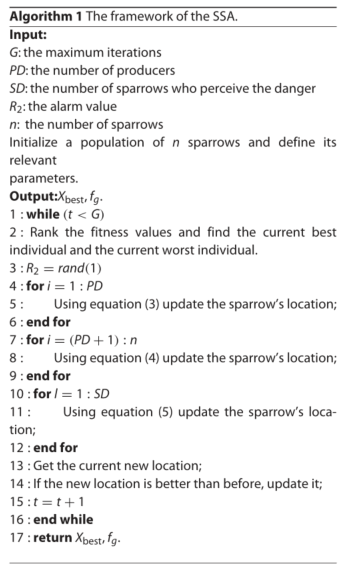
02.优化算法的流程
(1)生产者通常有高水平的能量储备,并为所有的拾荒者提供觅食区域或方向。它负责确定可以找到丰富食物来源的地区。能量储备的水平取决于对个体适应度值的评估。
(2)一旦麻雀发现捕食者,它们就开始鸣叫,作为警告信号。当告警值大于安全阈值时,生产者需要将所有行乞者引导至安全区域。
(3)每只麻雀都可以成为生产者,只要它寻找更好的食物来源,但生产者和乞丐的比例在整个种群中是不变的。
(4)能量较高的麻雀将充当生产者。几个饥饿的乞丐更有可能飞到其他地方寻找食物,以获得更多的能量。
(5)行乞者跟随能提供最好食物的生产者寻找食物。与此同时,一些行窃者可能会不断地监视生产者并争夺食物,以提高自己的捕食率。
(6)群中边缘的麻雀在意识到危险时迅速向安全区域移动,以获得更好的位置,而群中中间的麻雀则随机行走,以接近其他麻雀。
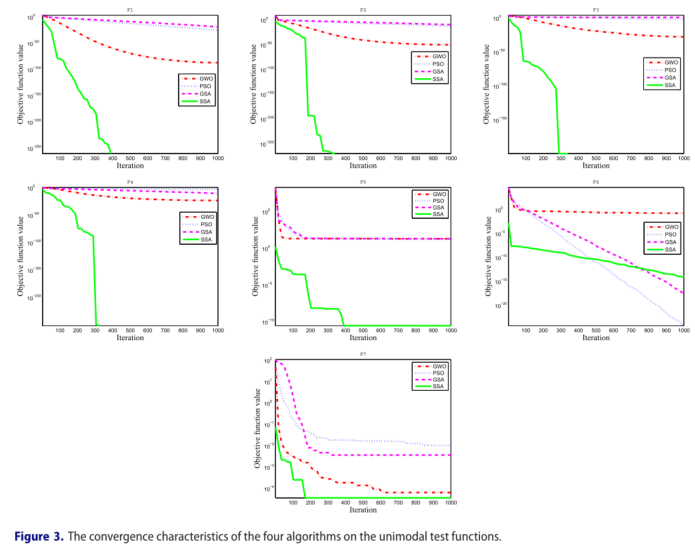
03.论文中算法对比图
04.部分代码
function [fMin , bestX,Convergence_curve ] = SSA(pop, M,c,d,dim,fobj  )
P_percent = 0.2;    % The population size of producers accounts for "P_percent" percent of the total population size
%%%%%%%%%%%%%%%%%%%%%%%%%%%%%%%%%%%%%%%%%%%%%%%%%%%%%%
pNum = round( pop *  P_percent );    % The population size of the producers
lb= c.*ones( 1,dim );    % Lower limit/bounds/     a vector
ub= d.*ones( 1,dim );    % Upper limit/bounds/     a vector
%Initialization
for i = 1 : pop

    x( i, : ) = lb + (ub - lb) .* rand( 1, dim );
    fit( i ) = fobj( x( i, : ) ) ;
end
pFit = fit;
pX = x;                            % The individual's best position corresponding to the pFit
[ fMin, bestI ] = min( fit );      % fMin denotes the global optimum fitness value
bestX = x( bestI, : );             % bestX denotes the global optimum position corresponding to fMin
  % Start updating the solutions.
for t = 1 : M


  [ ans, sortIndex ] = sort( pFit );% Sort.

  [fmax,B]=max( pFit );
   worse= x(B,:);

   r2=rand(1);
if(r2<0.8)

    for i = 1 : pNum                                                   % Equation (3)
         r1=rand(1);
        x( sortIndex( i ), : ) = pX( sortIndex( i ), : )*exp(-(i)/(r1*M));
        x( sortIndex( i ), : ) = Bounds( x( sortIndex( i ), : ), lb, ub );
        fit( sortIndex( i ) ) = fobj( x( sortIndex( i ), : ) );
    end
  else
  for i = 1 : pNum

  x( sortIndex( i ), : ) = pX( sortIndex( i ), : )+randn(1)*ones(1,dim);
  x( sortIndex( i ), : ) = Bounds( x( sortIndex( i ), : ), lb, ub );
  fit( sortIndex( i ) ) = fobj( x( sortIndex( i ), : ) );

  end

end
 [ fMMin, bestII ] = min( fit );
  bestXX = x( bestII, : );
   for i = ( pNum + 1 ) : pop                     % Equation (4)

         A=floor(rand(1,dim)*2)*2-1;

          if( i>(pop/2))
           x( sortIndex(i ), : )=randn(1)*exp((worse-pX( sortIndex( i ), : ))/(i)^2);
          else
        x( sortIndex( i ), : )=bestXX+(abs(( pX( sortIndex( i ), : )-bestXX)))*(A'*(A*A')^(-1))*ones(1,dim);
         end
        x( sortIndex( i ), : ) = Bounds( x( sortIndex( i ), : ), lb, ub );
        fit( sortIndex( i ) ) = fobj( x( sortIndex( i ), : ) );

   end
  c=randperm(numel(sortIndex));
   b=sortIndex(c(1:20));
    for j =  1  : length(b)      % Equation (5)
    if( pFit( sortIndex( b(j) ) )>(fMin) )
        x( sortIndex( b(j) ), : )=bestX+(randn(1,dim)).*(abs(( pX( sortIndex( b(j) ), : ) -bestX)));
        else
        x( sortIndex( b(j) ), : ) =pX( sortIndex( b(j) ), : )+(2*rand(1)-1)*(abs(pX( sortIndex( b(j) ), : )-worse))/ ( pFit( sortIndex( b(j) ) )-fmax+1e-50);
          end
        x( sortIndex(b(j) ), : ) = Bounds( x( sortIndex(b(j) ), : ), lb, ub );

       fit( sortIndex( b(j) ) ) = fobj( x( sortIndex( b(j) ), : ) );
 end
    for i = 1 : pop
        if ( fit( i ) < pFit( i ) )
            pFit( i ) = fit( i );
            pX( i, : ) = x( i, : );
        end

        if( pFit( i ) < fMin )
           fMin= pFit( i );
            bestX = pX( i, : );


        end
    end

    Convergence_curve(t)=fMin;

end
% Application of simple limits/bounds
function s = Bounds( s, Lb, Ub)
  % Apply the lower bound vector
  temp = s;
  I = temp < Lb;
  temp(I) = Lb(I);

  % Apply the upper bound vector
  J = temp > Ub;
  temp(J) = Ub(J);
  % Update this new move
  s = temp;
%---------------------------------------------------------------------------------------------------------------------------
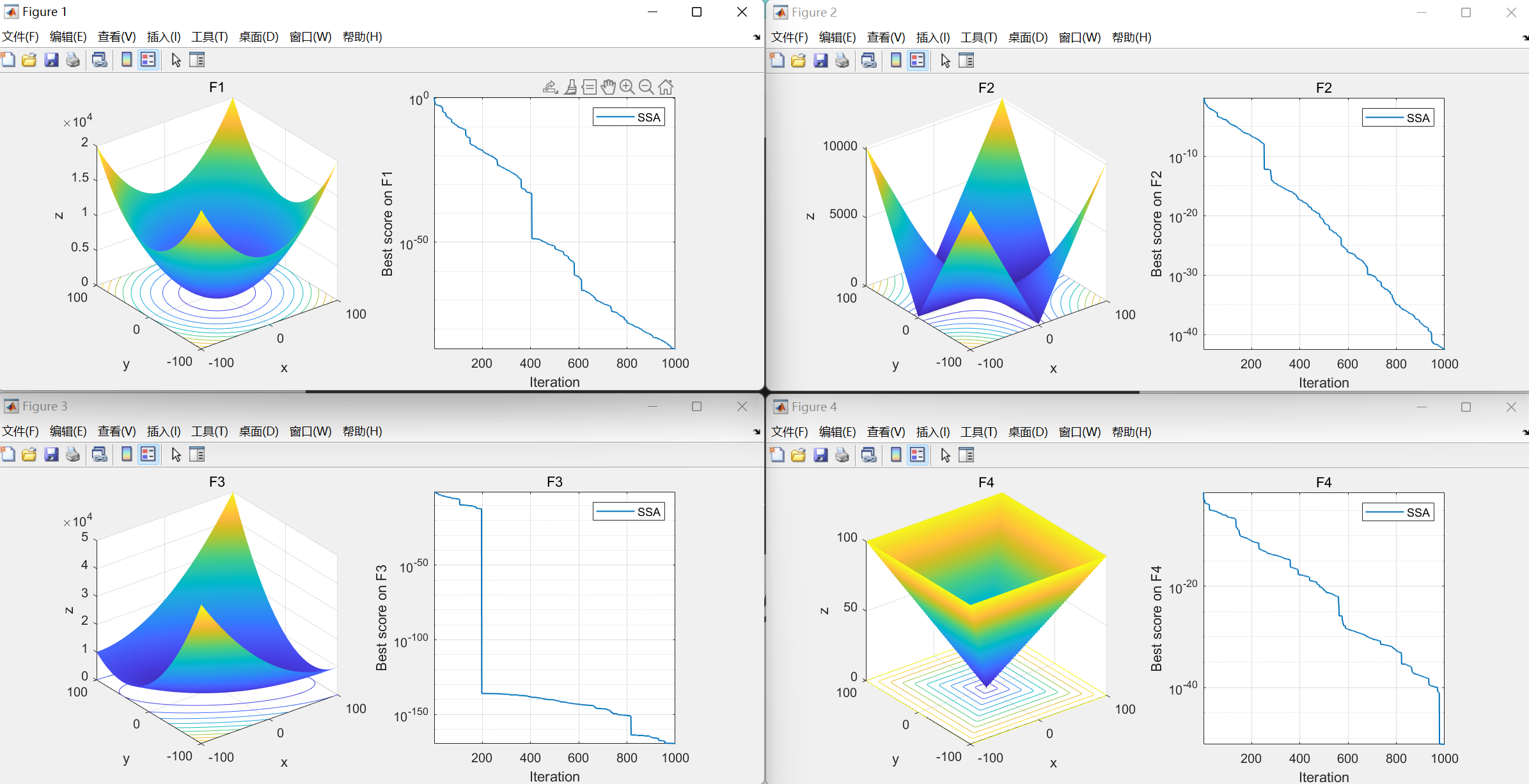
04.本代码效果图